Monday of the Twelfth Week in Ordinary Time

Reading I 2 Kings 17:5-8, 13-15a, 18

Shalmaneser, king of Assyria, occupied the whole land
and attacked Samaria, which he besieged for three years.
In the ninth year of Hoshea, king of Israel
the king of Assyria took Samaria,
and deported the children of Israel to Assyria,
setting them in Halah, at the Habor, a river of Gozan,
and the cities of the Medes.

This came about because the children of Israel sinned against the LORD,
their God, who had brought them up from the land of Egypt,
from under the domination of Pharaoh, king of Egypt,
and because they venerated other gods.
They followed the rites of the nations
whom the Lord had cleared out of the way of the children of Israel
and the kings of Israel whom they set up.

And though the LORD warned Israel and Judah
by every prophet and seer,
“Give up your evil ways and keep my commandments and statutes,
in accordance with the entire law which I enjoined on your fathers
and which I sent you by my servants the prophets,”
they did not listen, but were as stiff-necked as their fathers,
who had not believed in the LORD, their God.
They rejected his statutes,
the covenant which he had made with their fathers,
and the warnings which he had given them, till,
in his great anger against Israel,
the LORD put them away out of his sight.
Only the tribe of Judah was left.

Responsorial Psalm Psalm 60:3, 4-5, 12-13

R. (7b) Help us with your right hand, O Lord, and answer us.
O God, you have rejected us and broken our defenses;
you have been angry; rally us!
R. Help us with your right hand, O Lord, and answer us.
You have rocked the country and split it open;
repair the cracks in it, for it is tottering.
You have made your people feel hardships;
you have given us stupefying wine.
R. Help us with your right hand, O Lord, and answer us.
Have not you, O God, rejected us,
so that you go not forth, O God, with our armies?
Give us aid against the foe,
for worthless is the help of men.
R. Help us with your right hand, O Lord, and answer us.

Alleluia Hebrews 4:12

R. Alleluia, alleluia.
The word of God is living and effective,
able to discern reflections and thoughts of the heart.
R. Alleluia, alleluia.

Gospel Matthew 7:1-5

Jesus said to his disciples:
“Stop judging, that you may not be judged.
For as you judge, so will you be judged,
and the measure with which you measure will be measured out to you.
Why do you notice the splinter in your brother’s eye,
but do not perceive the wooden beam in your own eye?
How can you say to your brother,
‘Let me remove that splinter from your eye,’
while the wooden beam is in your eye?
You hypocrite, remove the wooden beam from your eye first;
then you will see clearly
to remove the splinter from your brother’s eye.”

- - -

Lectionary for Mass for Use in the Dioceses of the United States, second typical edition, Copyright © 2001, 1998, 1997, 1986, 1970 Confraternity of Christian Doctrine; Psalm refrain © 1968, 1981, 1997, International Committee on English in the Liturgy, Inc. All rights reserved. Neither this work nor any part of it may be reproduced, distributed, performed or displayed in any medium, including electronic or digital, without permission in writing from the copyright owner.


Read more
Deno Desktop
Read more
Won’t Somebody Please Think Of Banning The British Children!

The British government is in a headlong rush to ban under-16s from social media, and restrict the access of under-18s. And in typical form, the EFF is here with a warning about the dangers and futility of such legislation.

A satirical mock-up of what UK Prime Minister Keir Starmer's driving licence might look like, courtesy of https://use-their-id.com/
Kids aren’t stupid. They’ll use a fake ID like this one from the satirical https://use-their-id.com/ . Or they’ll become VPN experts.

The proposed new law will involve an age restriction policed through online ID verification, something which will not be limited to the young, as every British adult will also have to show ID to access large parts of the Internet.

There is little in the way of information about how this unprecedented invasion of privacy will be implemented, however we expect that it will be left to the lax security measures of a range of lowest-bidder third party identity verification services. The resulting database will become a very rich target indeed.

The EFF pull no punches in warning of the harms these measures will bring upon those it seeks to protect. Far from “Giving under-16s their childhood back” as it is being promoted, they warn that it will deprive them of access to community, friends, and distant family, as well as educational content that could be vital for them.

If it works at all. Certainly he more technically minded youth will put their efforts into the world of computer networking. A VPN ban is reportedly in the works, so a whole generation of future software developers and IT specialists will get their start running software to get round this on their Raspberry Pi.

We’ve reported on the EFF’s concerns over UK ID laws before.


Header image: Diliff, CC BY-SA 2.5.

Read more
Danish privacy activist Lars Andersen raided by police
Read more
Danish privacy activist Lars Andersen raided by police
Read more
TikTok Shows 3x More AI Slop Than YouTube, Report Finds

"About 59% of TikTok videos served to a new account's For You feed are AI slop," writes Search Engine Journal, "according to a report from Kapwing, the video creation tool company. That's roughly three times the rate Kapwing found on YouTube." The company manually reviewed over 10,000 TikTok videos across 20 categories and ran a separate fresh-account test, counting AI-generated content in the first 500 For You videos. Kapwing ran the same fresh-account test on YouTube and found that 104 of the first 500 Shorts, or 21%, were AI slop. On TikTok, 294 of 500 For You videos hit that threshold... Of the 2,000 videos Kapwing reviewed in TikTok's Kids category, 57% were AI slop. That was the highest rate of any category in the analysis. The highest-rate tag was #cartoonkids, where 97 of 100 featured videos were AI-generated. Tags like #cartoons and #babysong both reached 83%, and #forkids came in at 79%. After Kids, the next highest AI slop rates were in Science and Education (35%), Health (33%), and History (33%). All three are categories where visual illustration and voiceover narration make up much of the content. On the other end, categories where on-camera presence or physical demonstration are central had the lowest rates. Fashion came in at 1.3%, Music at 1.5%, and Fitness at 1.6%. The article notes that by last November, TikTok "had already labeled 1.3 billion videos as AI-generated, according to the report."

Read more of this story at Slashdot.

Read more
The Flat Curve Society
Read more
Canadian government spent $46.8M on a secret Palantir contract
Read more
Sakana Fugu
Read more
Brewing Espresso with Ultrasonic Assistance

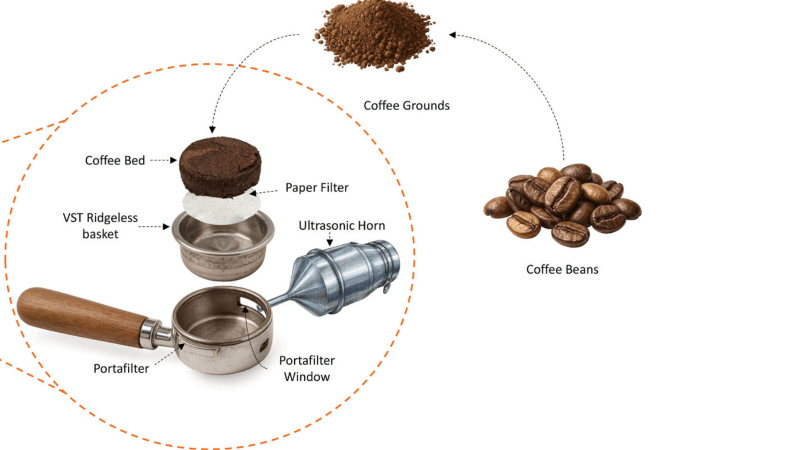
An AI-generated diagram of the coffee-making process is shown. A filter holds a basket of coffee grounds, which are contained in a paper filter. An ultrasonic transducer vibrates the basket.

There are as almost as many kinds of coffee as there are of coffee drinkers, with each method for preparing the beverage appealing to a different kind of palate: moka pots, filter coffee, pour-over coffee, French presses, cold brews, espresso, and more produce their own unique flavours by extracting different compounds from the grounds to different degrees. Now, a new method has joined the throng: ultrasonic-assisted extraction, which can produce even an espresso at room temperature.

Espresso is normally made by forcing hot water through tightly-packed, finely-ground coffee beans, quickly producing a concentrated extraction. Its one of the hardest kinds of coffee to consistently make well, since the outcome is influenced by everything from grind size and packing density to temperature, pressure, and more. Ultrasonic agitation helps here by creating cavitation bubbles, which form shock waves as they collapse, breaking open the bean structure and producing small, strong jets of water. The experimental apparatus was built into a modified espresso machine. An ultrasonic transducer delivers vibrations to the basket containing the room-temperature slurry of coffee grounds for two or three minutes.

To quantify the results, the researchers analysed total dissolved solids, extraction yield, pH, colour, volatile components, and caffeine and chlorogenic acid contents. By varying ultrasonic power and grind size, the extraction yield and dissolved solids could be adjusted to closely match traditional espresso or cold-brew coffee. The other metrics had no significant differences, and a survey of 100 coffee drinkers found no preference between this and traditional espresso. When the drinkers tried the cold-brew coffees, they preferred the version made with ultrasonic assistance. The experiment succeeded in its goal of reducing energy consumption: the ultrasonic-assisted coffee took about a quarter as much power to make.

If you still prefer a more traditional approach, we’ve covered some beautiful espresso machines before, including one made out of motorcycle engine parts.

Read more
Someone Forked systemd Over Its New Birth Date Field

The blog Linuxiac reports: A new systemd fork has appeared with a specific purpose: removing systemd's recently added support for storing a user's birth date in JSON user records. The fork, called Liberated systemd, published its first tagged release as v261 shortly after the official systemd 261 release. In other words, the fork follows upstream systemd while reverting the change that added the new optional birthDate field. Importantly, this is not a new init system, a wider redesign of systemd, or a general-purpose alternative to the upstream project. Its stated purpose is to remain close to upstream systemd while removing what the author describes as "surveillance enablement"... The author recommends testing the fork in a virtual machine before using it on real hardware and warns nightly builds are more likely to be unstable than named releases.

Read more of this story at Slashdot.

Read more
You're probably using Agent Skills wrong
Read more
The Doom Justifies the Valuation
Read more
Claude: Elevated Error Rates for Opus 4.8, Opus 4.7, Opus 4.6, and Sonnet 4.6
Read more
Early AMD GCN GPUs Seeing Improved GPU Recovery - Another Valve-Led Linux Improvement

Early AMD Radeon Graphics Core Next "GCN" GPUs are seeing work to improve the GPU recovery process in the event of hangs. This work is yet another improvement for older AMD GPUs being led by Valve's open-source Linux graphics driver team...

Read more
1983 Northern Telecom Commodore Phone
Read more
New Super Pac Aims to Rally Tech Workers to Help Limit A.I
Read more
Petition against Meta's employee training data collection for ML models
Read more
The Secret Revolution in Battery Technology: 3-D Printing

"There's a revolution in battery technology hiding in plain sight," reports The Wall Street Journal. "The 3-D printing of batteries has the potential to put energy storage inside any device. "This will enable lightweight and long-lasting consumer gadgets, long-range military drones and even nanoscale robots." Almost all the innovations we regularly hear about — from cheaper, tougher electric-vehicle batteries to "Holy Grail" solid-state batteries — are about changing the chemistry of batteries. The promise of battery-tech 3-D printing (aka additive manufacturing) is simple: What if batteries could fill any available space, even structural elements of our gadgets, rather than always taking a rigid shape like a pouch or cylinder? The new approach has obvious appeal. The entire airframe of a drone could be filled with energy storage for increased range. Smartglasses could have sleek battery-packed frames, so they look like everyday eyewear rather than "Revenge of the Nerds" props. One of the biggest advantages of 3-D printing is that it works with any battery, regardless of its cell chemistry. It could advance today's lithium-ion as well as emerging sodium-ion and solid-state tech... Some [startups] are trying to use 3-D printing to create efficiencies in existing battery manufacturing systems. A brave handful of startups are pursuing radical new designs and approaches. They're starting with defense applications, where cost and scale are less of an issue... At Silicon Valley-based Sakuu... [r]ather than trying to 3-D-print whole batteries, the company is working on replacing one of battery manufacturing's biggest pain points, says Arwed Niestroj, Sakuu's chief operating officer, who is also a nuclear physicist and former head of Mercedes-Benz Research & Development North America. Existing battery assembly lines include football-field-long ovens for drying layers of material that have been dissolved in solvents. This requires a huge amount of energy and is a significant contributor to manufacturing costs, a big reason EV batteries aren't cheaper. Sakuu's process, under development for years, uses additive manufacturing to lay down key battery components without solvents, eliminating the need for ovens, says Niestroj. Sakuu is currently working to commercialize this tech with a major battery manufacturer...

Read more of this story at Slashdot.

Read more
Hackaday Links: June 21, 2026

Hackaday Links Column Banner

Today marks the summer solstice, the longest day of the year and the start of astronomical summer in the Northern Hemisphere. This doesn’t really have much to do with hacking hardware or building gadgets other than the fact that from this point on you’ll have progressively less daylight hours to do it in each day. Of course, if you do your best work in the middle of the night this won’t impact things much.

If you’re as likely to find a controller in your hand as a soldering iron in the evenings, you might be interested in a recent filing against Sony. Lawyers representing a group of four gamers allege that the entertainment giant is violating a California law that says digital storefronts need to make it clear that buyers don’t technically own the games in question but are merely licensing them — a license which, as we’ve seen in the past, can be revoked or modified at any time with no restitution made to the purchaser.

Now while we agree conceptually that selling gamers a license rather than an actual copy of the game is clearly a one-sided deal, we’re still not sure this case has a lot of merit. As far as we can tell, Sony does make it clear in the fine print that you’re not really going to own anything once they take your money. Or, at the very least, they make it equally as clear as any other company that’s selling digital downloads these days. Should the court actually find that said fine print is a little too fine, it could conceivably have ramifications throughout the entertainment industry. This is certainly a case to keep an eye on.

If you want to be sure none of your games can be removed from your digital grasp without warning, perhaps your best bet is to stick to the classics. Fans of 1989’s F-15 Strike Eagle II on PC will be excited to hear that there’s an ongoing effort by Neuvieme Porte to reverse engineer the flight sim and re-implement the whole thing in portable C.

This would open up all sorts of possibilities, such as ports to other platforms and the addition of new features and content. But before the project can get to that point however, Neuvieme is looking to recruit some virtual test pilots. Just keep in mind that the goal, at least for now, is to recreate the game exactly. That means bugs present in the original release are to be preserved. As such, it would help to have logged enough hours back in the DOS days to recognize what’s an OG bug and what’s been newly introduced.

From working on virtual jet fighters to the real deal, IEEE Spectrum recently ran an article about a startup called Phoenix Semiconductor that’s looking to produce bespoke pin-compatible replacements of critical chips for the military. They reason that the Air Force won’t mind paying $1,000 for a chip that cost them a buck back in 1975 when the alternative is grounding a $70+ million F-18 that needs the thing to take off. The goal isn’t really to recreate the old parts as they were, but instead to build drop-in replacements that are tailored for specific applications. In other words, Uncle Sam doesn’t care of the IC actually looks like the original, so long as it fits and it gets the jet up in the air again.

Finally, on the subject of aerospace technology, NASA’s Jet Propulsion Laboratory published a blog post earlier this week detailing their work on the Exploration Rover for Navigating Extreme Sloped Terrain (ERNEST). While NASA’s Curiosity and Perseverance rovers have done some incredible work on Mars, they’re slow and have to be operated with the utmost caution to make sure they don’t get stuck. In comparison, ERNEST is several times faster and is designed with an active suspension system that lets it lift each wheel up off the ground independently if needed.

The prototype rover also features improved autonomy that may allow future rovers make more decisions on their own. That may not be a huge time saver on the Moon, but given the communication delays with the Red Planet, a Mars rover that doesn’t have to stop and ask Earth for directions so often will be able to get more useful work done at the end of the day.


See something interesting that you think would be a good fit for our weekly Links column? Drop us a line, we’d love to hear about it.

Read more
Good results fine tuning a local LLM like Qwen 3:0.6B to categorize questions
Read more
Simple hard way to conjugate Japanese verbs
Read more
The Deadly Rise of Giant Trucks and S.U.V.s
Read more
I Gave an AI a Civilization to Run. It Built a Nuke – Launching CivBench
Read more
Is Tesla Planning To Sell Modular AI Data Center Hardware?

Electrek reports: Tesla wants to sell modular AI data center hardware, according to a new trademark application for a product called "Megapod." The filing describes a complete, self-contained computing system for AI workloads... Tesla filed the "Megapod" trademark (serial number 99893717) with the U.S. Patent and Trademark Office this month, through its longtime IP counsel. It's an intent-to-use application, meaning Tesla is claiming the name for a product it hasn't launched yet. The goods-and-services description is unusually specific for a trademark. Megapod covers "modular data center hardware systems for artificial intelligence computing, comprised of computer servers, computer hardware for artificial intelligence data processing, networking equipment, power distribution units, and cooling systems." It also covers "self-contained modular computing hardware systems for artificial intelligence workloads," integrated platforms sold as a single unit — an enclosure bundling compute, power distribution, and cooling — and downloadable software to monitor, manage, and optimize those systems. In plain terms: Tesla wants to sell a turnkey AI data center building block. Not a battery, not a chip on its own, but the full rack-and-room of servers, networking, power, and cooling that AI training and inference run on. Tesla's offering would have to compete with Nvidia's liquid-cooled, rack-scale systems that simulates a giant GPU, the article points out. But "The bigger issue is that Tesla has no merchant compute-hardware business to build on." Tesla's own AI training cluster, Cortex at Gigafactory Texas, runs on roughly 67,000 Nvidia H100-equivalent GPUs. In other words, Tesla is one of Nvidia's customers, not a competitor selling alternative hardware... Where Tesla does have a real AI-data-center business is power, not compute. Its Megapack and new Megablock energy storage products are selling into AI data centers as grid buffers — Musk's own xAI has bought roughly $1 billion of Megapacks to keep its training runs powered. That energy-storage strength is the one credible thread here. A Megapod that bundles Tesla's power electronics, thermal management, and the enclosure — the "shell" around the chips rather than the chips themselves — would at least sit adjacent to a business Tesla actually runs.

Read more of this story at Slashdot.

Read more
Rent collections are down in New York – and no one's sure why
Read more
Did my old job only exist because of fraud?
Read more
The Anatomy of an AI-Native Org
Read more
My 1992 view of the problems of computer programming in 1992
Read more
FDA advisors unanimously vote to approve Moderna's mRNA after agency drama
Read more
Apertus – Open Foundation Model for Sovereign AI
Read more
PowerFox Browser
Read more
NSA chief says Mythos breached 'almost all' classified systems in hours
Read more
Everything Is Logarithms
Read more
Stop wasting tokens and re explaining your project between sessions
Read more
There is minimal downside to switching to open models
Read more
UK Official Promises Statements 'Around VPNs' and Further Teen Restrictions on Chatbots and Social Media

PC Gamer reports: The UK government is considering an Australia-style ban on social media for under-16s, with Prime Minister Keir Starmer saying that the ban could take effect as soon as spring next year. As for the much nearer future, Science and Technology Secretary Liz Kendall told BBC Breakfast earlier this week, "We will make further statements in July about VPNs and further restrictions." To be clear, no specific restrictions have yet been announced and Kendall sounded somewhat cautious about an outright ban during a parliament debate that took place the same day. "I have commissioned further research about their usage. There are really important issues to balance here," she says. "Many people want to use VPNs for privacy — that is important — but we know that some children use them to get around restrictions. I will come back to that in July in our response to the consultation." So, we'll have to wait until next month for anything definite, but it's hard not to feel like a full ban on VPNs is already on the table. If that does come to pass, more than the contents of my Bluesky inbox will be at stake. Utah in the US has already tried to implement a full VPN ban (though this was postponed until September after Aylo, the parent company of Pornhub, challenged the law in court)... [T]he UK could just be the next domino after Utah, potentially setting off a chain reaction that affects users around the world. The article also argues that age checks can also be a privacy nightmare "with the security breach that exposed the personal info of 70,000 Discord users last year being one case in point." Here's the complete statement from UK Technology Secretary Kendall. "I'll come back in July with a further statement around VPNs but also additional measures that we want to look at, further restrictions on AI chatbots that parents have found very worrying, more about overnight curfews or breaks in doomscrolling for 16- and 17-year-olds."

Read more of this story at Slashdot.

Read more
Ask for no, don't ask for yes (2022)
Read more
SmallRun.net Enters the Marketplace Market

So you have a project that you love, and everyone else loves too. People start saying “you should sell this” but where? Well, there’s a new marketplace you might want to consider called called SmallRun, aiming at makers and their, well, small production runs.

SmallRun will absolutely host your custom PCBs, on-demand 3D prints, and other traditional maker products — but they’ll also happily sell your merch, too. Along with electronics and hardware, they aim to allow you to sell products in categories like tabletop gaming, sciences, and yes, accessories/apparel.

For sellers, they offer automatic payouts and promise to take care of the taxes by integrating with Stripe. That said, they’re still working on getting the whole VAT thing set up for products imported to the EU. EU to EU sales are apparently OK. They’ll host build logs, which may drive engagement with your product. There’s even a handy tool to import your existing listings from eBay, Tindie, Lectronz, Etsy, Shopify, or Crowd Supply if you’re already in the biz. They make their money by taking a cut of your sales: eight percent, plus forty cents per listing.

Depending on your perspective, you might wonder if we need another marketplace, To that we can only say: “Let a thousand flowers bloom!” Competition should drive these marketplaces to continuously improve and we all win.

If you’re selling online, even packaging can become a project. If you’re not, but are interested in starting, our “From Project to Kit” series from ten years back remains surprisingly relevant.

Thanks to [Aron] for the tip!

Read more
Cops Keep Getting Arrested for Using Flock's Cameras to Stalk People

404 Media remembers how a Florida police office looked up his ex-girlfriend's license plate in the Flock automated license plate reader system at least 69 times in 2024 — even searching for her mom's license plate at least 24 times. The police office was charged with stalking and hacking-related offenses, serving one day in prison with five years of probation — but his case "was not a one-off." [Alternate link via Bruce Schneier] Local news reports from around the country repeatedly detail police abusing the Flock surveillance system in order to stalk their partners or ex-partners. The contours of each story are much the same, with the police officer in question using their access to the system to repeatedly track a specific person over the course of weeks or months. The cases highlight the fact that Flock can be used to track the whereabouts of individual people, that police do not get a warrant in order to use the system, and that, if they have access to the system, they have the technical ability to look up any license plate they want for any reason they want. An April study by the civil rights group Institute for Justice found that at least 18 police officers have been caught around the country using Flock to stalk a romantic interest in the last few years; another database, called the ALPR Abuse Library, has documented 20 specific cases of "stalking/targeting" around the country. The known cases of police stalking are almost certainly a vast underreporting of the overall abuse, because they largely include only cases in which the behavior was so egregious that it led to police officers being fired, arrested, or both. Flock told 404 Media that it is "aware of 15 incidents of abuse, each surfaced because of the transparency and accountability features deliberately built into our platform.... There are also 140,000 monthly active users of Flock, so the relatively rare instances of abuse, while obviously wrong and awful, are exactly that — rare," a Flock spokesperson told 404 Media. [One in 10,000.] "Humans are fallible; unlike most tools society provide law enforcement, Flock ensures that in the instances when our technology is misused, the evidence used to hold responsible parties accountable, is right there in our system. We also encourage all our customers to have a usage policy, regular training, and to implement our Audit Assistance tool, which proactively flags unintended use...." But it is also the case that Flock has strenuously fought against lawsuits and potential regulations that are seeking to require police to get a warrant to use the system. And many cases of abuse have not been detected by police departments themselves but by those private citizens, journalists, and stalking victims who have found patterns of abuse in public records files they have obtained from their local police departments. In most cases of Flock-related stalking reviewed by 404 Media, the abuse occurred over the course of months or years, and the victims were subjected to dozens or hundreds of lookups. Other abuse cases have been discovered using the website HaveIBeenFlocked.com, a website that compiles Flock searches released via public records requests and turns them into a searchable database. Flock has repeatedly tried to get that website taken down, as we have previously reported.

Read more of this story at Slashdot.

Read more
zlib-rs 0.6.4 Released With Fix For Intel Raptor Lake Crash, SIMD Optimizations

As a follow-up to last week's article around Firefox leveraging zlib-rs and some nice upstream improvements to this Rust-based Zlib implementation, the zlib-rs 0.6.4 release is now available to ship all of these latest enhancements...

Read more
Show HN: CleverCrow: give tokens to your favorite projects
Read more
JSON-LD Explained for Personal Websites
Read more
After Six Years Of Work and Over 360 Patches, Linux 7.2 Finally Removes Bug-Prone strncpy

Tech Times reports: Linux 7.2's merge window closed out a cleanup campaign on Friday that most kernel developers had stopped expecting to see end: the complete removal of strncpy(), a C string-copy function that the kernel's own documentation labels "actively dangerous," from every subsystem, driver, and architecture-specific file in the kernel source tree. The merge landed June 20, 2026. After around 362 commits spread across six years of incremental work, no call site using the function remained, and the function itself — including the last per-CPU-architecture optimized implementations — was struck from the source. The removal matters beyond housekeeping. strncpy() is a persistent source of a specific class of memory error: kernel buffers that contain sensitive data can leak bytes past an unterminated string boundary, a pattern that enables memory disclosure vulnerabilities. Eliminating the function from the tree removes that entire class from the kernel's attack surface — and, critically, makes strncpy() unavailable to any future contributor, turning a best-practice suggestion into an enforced policy. Phoronix notes it's replaced by five different functions: In place of strncpy, Linux kernel code should use strscpy() for NUL terminated destinations, strscpy_pad() for NUl-terminated destinations with zero-padding, strtomem_pad() for non-NUL-terminated fixed-width fields, memcpy_and_pad() for bounded copies with explicit padding, or memcpy() for known-length memory copies. "The reason five functions were needed," explains Tech Times, "is that different parts of the kernel were using strncpy() for five semantically distinct memory operations — each with a different intent, different termination requirement, and different padding behavior. " The original function obscured all of those differences under a single ambiguous name. The 362-commit campaign to replace it was, in effect, a codebase-wide audit that forced every call site to declare its actual intent in code That is an engineering outcome with lasting value: the kernel's string-handling semantics are now explicit where they were previously implicit, and future maintainers can read a function name and understand what a copy operation actually does.

Read more of this story at Slashdot.

Read more
Trump admin’s coal investments assist plants with repeated violations

In 2023, after years of pollution, equipment failures, and health concerns, the Cumberland Fossil Plant in Tennessee was slated to close within the decade.

The coal-fired plant had been part of a multibillion-dollar settlement in 2011 after its operator, the Tennessee Valley Authority, failed to install pollution control technology a decade earlier. Regulators cited the plant for more air-pollution violations in 2017 and 2023. TVA said it would shutter Cumberland’s units in 2026 and 2028.

Then the Trump administration replaced four of TVA’s board members, and the agency reneged on its retirement plan in February. Now, TVA has a federal pledge for $46 million to extend Cumberland’s lifespan—part of a nationwide push by President Donald Trump to keep older coal plants running.

Read full article

Comments

Read more
Health Insurance Claim Denial Rates Range from 13% to 35% by Insurer
Read more
Wildcard (YC W25) Is Hiring a Founding Applied ML Engineer
Read more
Tell HN: Happy Fathers Day to all the fathers, uncles, anyone in that role!
Read more
When a Favicon Becomes the Entire Website

Putting hidden data in places where few expect it can be a fun hobby or even a professional career. In the case of [Tim Wehrle] it’s just the former. His most recent project in this area uses a favicon image for storing a HTML-based website and rendering its contents within the browser after the favicon has been downloaded.

To pull this off, a very basic HTML page was turned into a series of UTF-8 encoded bytes that were then declared to be a standard PNG image. The original 208 byte payload plus 4-byte PNG header only used part of a 9×9 pixel favicon. With a larger favicon image as typically used you could thus easily store more data, whether as visual noise like here or a bit more hidden.

Of course there’s a catch, and in this case it’s the Typescript code to unpack the bytes from the “image” and render them; you have to load that separately. But still, in these days of all-singing, all-dancing websites that take forever to render, it’s refreshing to see what you can do with so few bytes that they fit in a favicon.

As for the purpose of such an approach, that’s left as an exercise for the reader, but you’re more than welcome to take a poke at the GitHub project and the demonstration site..


Read more
Burnout Is Real in the OSS World, Says John-David Dalton, Creator of Lodash
Read more
The Minimum Viable Unit of Saleable Software
Read more
US Bill Would Mandate AI Chip Location Tracking to Thwart China and Other Adversaries

NBC News reports: A group of companies that specialize in tracking international shipments of sensitive technologies is backing a Capitol Hill bill that would require America's most powerful AI chips to incorporate stronger security mechanisms aimed at preventing the chips from reaching China and other adversaries. The letter, signed by six companies, says the Chip Security Act (CSA) would increase American chip companies' competitiveness and close key loopholes in the U.S. export control regime. The move clashes with claims from semiconductor lobbying groups that the requirements would constrain America's booming chip industry. Sent to congressional leadership Thursday morning and seen by NBC News, the dispatch instead argues that more robust security verification would assure chip customers and manufacturers that they are abiding by sensitive restrictions on chip sales. The companies argue that the boosted confidence will "lead to increased sales, faster export approvals, larger transactions, greater access to new markets, and more expansive chip deals." Despite U.S. export control laws banning sales of advanced AI chips to certain countries, including China, loopholes in current requirements have allowed billions of dollars' worth of America's best AI chips to be sold to entities in third-party countries that can then forward them to China. In just one case in March, the Justice Department charged three people with conspiring to forward $2.5 billion of AI chips to China. The CSA aims to address those loopholes, mandating that chip exporters better track where advanced chips are sent, via either bespoke location-verification hardware or software that can run on existing hardware. That, bill proponents claim, would ensure that sensitive chips could be sold to countries like Malaysia or Indonesia without fear of further transfer to China... Experts say that because chips perform the advanced computations required for frontier AI systems, cutting off access to the chips is crucial to prevent geopolitical rivals from using AI systems for military or economic purposes.

Read more of this story at Slashdot.

Read more
AI Has Broken Hiring
Read more
Code duplication is far cheaper than the wrong abstraction
Read more
(How to Write a (Lisp) Interpreter (In Python))
Read more
The Rust Ecosystem Gets an AI Security Engineer in Residence

While the Rust Foundation has a Security Initiative to protect its ecosystem, "the threats have expanded," they announced this week, "and so has the kind of help maintainers need." Much of this comes back to a single shift: Automated tooling (much of it now built on large language models) has gotten good enough to surface real vulnerabilities in open source code quickly and at scale. That is useful, and several large Rust projects have already received and fixed credible issues found this way. The same tooling has also made it trivial to generate vulnerability reports that look plausible and are worthless. Maintainers across the ecosystem are losing real hours sorting these from the reports that matter, and the noise tends to bury the signal. So, with funding from the Alpha-Omega Project, the Rust Foundation is bringing on a full-time AI Security Engineer in Residence dedicated to the Rust ecosystem. This position is being funded with part of the $12.5M in open source security funding that the Linux Foundation announced in March. The role exists to take pressure off maintainers. The person in this position will use a mix of human-led and AI-assisted methods to proactively review Rust itself and the crates the ecosystem leans on most and help us separate real, exploitable issues from false positives and low-signal noise before anything reaches a maintainer... This role will run full-time for six months to start, with room to extend depending on what we learn and the funding available. Methods, playbooks, and prompts will be documented so the work doesn't end with the contract. We are grateful that Rust is not embarking on this work in isolation. Several other ecosystems have received parallel Alpha-Omega grants for the same kind of work (e.g., the PHP Foundation and the Drupal Association) and we plan to share tooling, triage practices, and what we learn rather than duplicating work A statement from Rust's new AI Security Engineer in Residence acknowledges that "One of our next challenges is the wave of bugs discovered by the next generation of AI-powered developer tools."

Read more of this story at Slashdot.

Read more
Former Olympian denies vandalising Washington Reflecting Pool after arrest
Read more
Fossil Fuels Are 40% of Freight Shipping Tonnage, but Half Its Fuel Use
Read more
Qualcomm Posts Linux Patches For HP EliteBook X G2q X2 Elite Laptop

Last month Qualcomm engineers posted patches bringing up the Lenovo Yoga Slim 7x Gen11 Snapdragon X2 laptop on Linux. Sent out this weekend were a new set of patches from Qualcomm for bringing up the HP EliteBook X G2q laptop model powered by the Snapdragon X2 Elite SoC...

Read more
Canonical's Upcoming AI Tool: Talk to Ubuntu Instead of Typing

This week the Ubuntu desktop's director of engineering announced they're bringing speech-to-text dictation to Ubuntu Desktop, aiming for an experience "that feels like a natural part of the desktop while respecting user privacy and running entirely on local hardware." "Speech recognition has become a common feature on modern platforms, and we think it should be a first-class experience on Ubuntu Desktop as well." More details from the blog It's FOSS: For Ubuntu 26.10, the initial version of Myna is expected to be a desktop dictation tool built around GNOME on Wayland with a push-to-talk mechanism gatekeeping when your microphone accepts input. Using it means holding a hotkey, speaking, and letting go. A small activity indicator shows while it is listening, and the transcribed text lands wherever the cursor was sitting when dictation started. Recognition itself happens inside a sandboxed component called the Canonical Inference Snap, while a Speech Orchestrator manages the session and an Audio Adapter handles whatever the microphone picks up, denoising and chunking it before it ever reaches the model... Speech recognition will happen locally, and an internet connection is not needed once the appropriate model is installed... The audio data won't be sticking around either, being stored in a small in-memory buffer that gets discarded the moment the session ends. Features like dictation into password fields, wake words, continuous listening, voice assistants, voice commands, translation, speaker identification, and automatic language detection are all off the table... You should also know that Canonical is looking for feedback before the specs for Myna are finalized, especially from people who already rely on dictation or assistive tools on Linux.

Read more of this story at Slashdot.

Read more
Who Owns Your ATProto Identity? Hint: It's Probably Not You
Read more
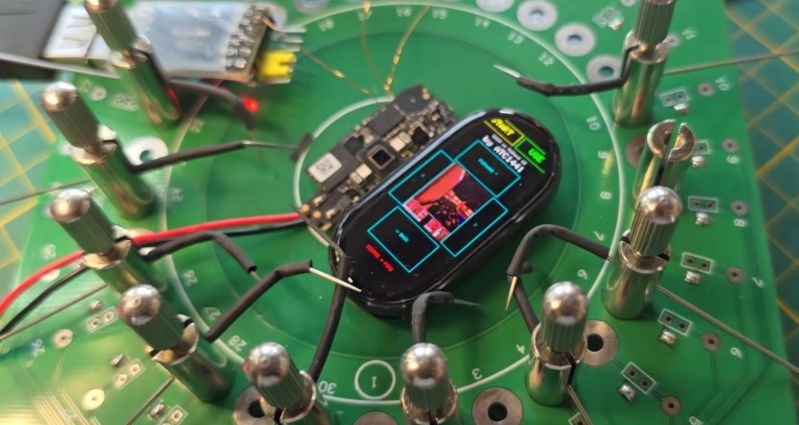
Hacking the Mi Band 10 Smart Band and its Bestechnic SoC

In between playing Doom on the most ergonomically challenged devices, [Aaron Christophel] likes to take a relaxing break with reverse-engineering Xiaomi Mi Band fitness trackers and writing custom firmware for them. Also so that he can play more Doom on those, natch. The latest subject comes in the form of the Mi Band 10, which features a BES2700iMP SoC, known internally at the manufacturer Bestechnic as the BEST1503. This is all documented on the GitHub project.

In the accompanying video we get some more details on this project, with the main challenge being that for this Mi Band 10 there’s no public SDK for its SoC. This was a major bummer until [Aaron] realized that the BEST1306 (BES2700IHC) is effectively the same SoC, but with a leaked SDK available via apparently audio-focused development kits. From there a BEST1503-compatible SDK could be assembled.

Naturally, to check that all of this was working correctly Doom was ported to the device courtesy of the GBADoom project. This mostly works aside from the display running in single-bit SPI mode instead of quad-SPI that it should be capable of, along with limited color depth. Despite burning all the tokens on the Claude, this provided little help, probably because the required information hasn’t leaked out of Bestechnic yet and ended up in the training data set.

Since the Mi Band 9 uses the same SoC, it’s expected that this reverse-engineered SDK will also work for that fitness band, though that hasn’t been tested yet.

Read more
AI Under Trump's Control: Can France Still Avoid Digital Dependence?
Read more
Artificial
Read more
I was wrong about the Midjourney ultra-sound scanner
Read more
Show HN: Teach your kids perfect pitch
Read more
Mesa 26.2 Merges Vulkan Present Timing Support For X11/XWayland

Mesa's Vulkan windowing system integration (WSI) code now has support for present timing support "VK_EXT_present_timing" with X11 and XWayland...

Read more
Anthropic to Require ID Verification for Certain Capabilities Starting July 8
Read more
David Ahl's Basic Computer Games Ported to C
Read more
100 Greatest Bird Names of All Time
Read more
Foreign-Born Entrepreneurs Drive America's Unicorn Boom
Read more
Beyond All Reason (Free Total Annihilation Inspired RTS)
Read more
New Super PAC Aims to Rally Tech Workers to Help Limit AI: 'the Guardrails Alliance'

"A grassroots movement is forming among everyday tech workers who are demanding their companies develop and deploy AI responsibly," reports TechCrunch. Hoping to leverage that discontent is a new super PAC called the Guardrails Alliance. The New York Times reports that it launched Thursday with backers that included tech employees and labor unions: Guardrails positions itself as a populist political movement that runs on small donations from people in the trenches of the AI boom. The PAC has about $5 million at its disposal today and planGuardrails will buy ads to support Alex Bores, a New York congressional candidate who became Leading the Future's first target and is running in the primaries next week. s to raise $15 million this cycle — small potatoes compared to deep-pocketed adversaries like Leading the Future, which has more than $100 million from tech leaders like OpenAI president Greg Brockman... "This is not about matching [Leading the Future] dollar for dollar," [said the super PAC's co-founder, political operative Shaunna Thomas]. "What this vehicle is meant to do is be a political home for people who are concerned about the way the anti-regulation AI tech sector is trying to manipulate elections." Meanwhile a former Netflix and Warner Bros. executive has launched the Alliance for Responsible Innovation in the Arts & Media, reports Variety, calling it an AI-focused content coalition that says it's dedicated to supporting "responsible and sustainable AI innovation and the importance of human creativity." The initial members of the coalition, announced Monday, include Disney, the New York Times, Adobe, Condé Nast, the Financial Times, ITV, Advance, BBC, Cambridge University Press & Assessment, U.K. publisher Reach and Wiley. Many of the coalition's members have either struck deals with AI companies or are developing their own AI tools... The group plans to argue for legal and policy guardrails around AI's usage, with its funding directed towards analyses, tools and services focused on advancing those initiatives... One of the group's launch advisers is Damian Collins, OBE, who previously served as the U.K. Parliamentary Under-Secretary of State in the Department for Science, Innovation and Technology under prime ministers Boris Johnson and Liz Truss. "Using AI to break the law can never be an acceptable excuse," he said in a statement. "Laws around personal safety, intellectual property and financial crime still apply in the age of AI. This is why ARIAM has been created and why I'm proud to working with this necessary initiative."

Read more of this story at Slashdot.

Read more
The case against geometric algebra
Read more
Blender 5.2: Coming Soon With Improved Simulations

Blender is one of the poster children for Open Source Software– proof that something hacked together by enthusiasts could grow to rival the big boys in 3D modeling, animation and rendering after it was abandoned by its original corporate owners. Once you climb that initial learning curve, which can indeed feel cliff-like, you can do almost anything in Blender you can in paid competitors– almost.

Traditionally, one of the weak points has been simulations, with even those working in Blender professionally offloading simulation to programs like Houdini. According to [3Dan], once version 5.2 is out of beta in July, that may become a thing of the past. 

Simulations aren’t a necessary part of a 3D animation software, but they are very, very nice to have. If you want realistic-looking fluids, hair, or cloth, it’s incredibly difficult to animate it by hand. One, because there are so many degrees of freedom in, say, flapping cloth, keyframing is a major pain, but also figuring out how to make the model move and deform realistically is by no means trivial. It’s easier to offload all that on a physics simulation; then, as long as the physics is realistic, the animations will be as well.

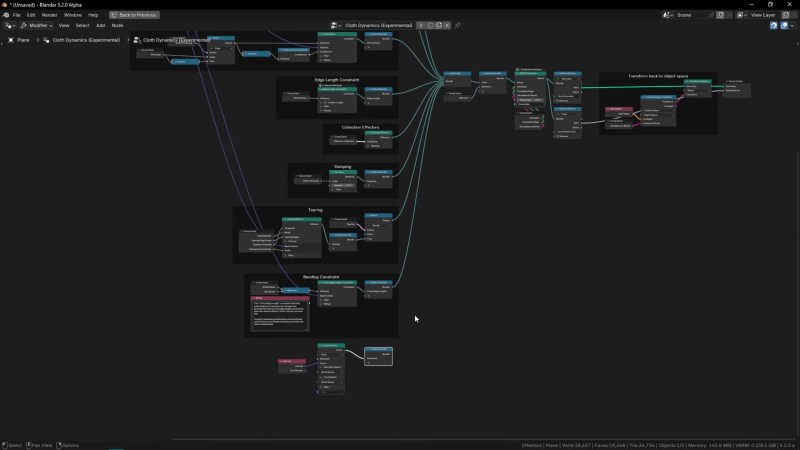
That’s not easy, computationally speaking, and one thing that’s clear is there’s been work behind the scenes to optimize the simulation algorithms, not just improve the workflow, as the basic “drop cloth on a monkey head” demo now runs twice as fast. The new workflow itself bring simulations more into line with how Blender has been going– it’s part of geometry nodes now. So there’s simulation nodes you bring in, but that means things like tearing cloth become quite straightforward compared to the occasionally byzantine workarounds required before. This node-based workflow also brings Blender more into line with how paid software works these days.

[Dan] demonstrates the power of it by adding air pressure to a cloth simulation with some custom nodes, inflating and popping a fabric sphere. He also demonstrates how cloth simulation can be applied to animate realistic foliage. This update probably doesn’t have Houdini developer SideFX shaking in their boots, but it might allow some animators to stop paying that license and go fully-open source, which is great to hear.

While the work on the simulations engine is raising the bar on what was, traditionally, one of the weak points of the software, v5.2 brings oodles of improvements across the whole gamut of what blender can do– which is a lot. See them all on the official release notes. Even if you’re not into digital sculpting or animating, you may find yourself downloading a copy of Blender at some point to add texture to 3D prints, or make fancy resin-print miniature models FEM-friendly. The right addon can even let Blender do parametric CAD, if you want open-sorce and can’t stand FreeCAD. Though FreeCAD is getting better all the time, too.

Read more
TypeScript 7 RC: the compiler rewritten in Go, around 10x faster
Read more
Google's Gemini Partially Figures Out A Lengthy Linux Boot Time On Modern ASUS Laptop

Google Antigravity with the Gemini 3.5 Flash model helped a Linux user sort out a situation where his laptop was taking around 36 seconds to boot the kernel, which shouldn't be the case for the high-end laptop with AMD Ryzen 9 processor and 32GB of RAM. It ended up being yet another case of device firmware issues, but now a Linux kernel patch is pending for working around the issue on the ASUS ROG Strix G16 G614 laptop while discussions are ongoing in getting the vendor to provide a proper firmware fix...

Read more
Review: Widow's Bay is a boldly original take on comedic horror

Widow's Bay, the delightfully eccentric new comedic horror series from Apple TV, is easily one of the best new series of the year. There's a reason everyone from Guillero del Toro and Ben Stiller to Damon Lindelolf (Lost) is raving about the show. It's an eminently binge-able, addictive series that pays tribute to all the classic horror tropes while reinventing them in surprising ways. Think Stephen King meets Parks and Recreation, with a dash of Twin Peaks—except Widow's Bay is very much its own refreshingly original beast.

(Some spoilers below but no major reveals.)

Tom Loftis (Matthew Rhys) is a widower and mayor of Widow's Bay, a quirky little seaside town that has a colorfully bizarre history marked by periodic tragedies. Tom is eager to elevate the town into a trendy summer tourist destination. But the arrival of New York Times travel writer Arthur Lloyd (Bashir Salahuddin), who has the clout to make Tom's aspirations for Widow's Bay come true, coincides with the onset of a mysterious fog. Local resident Wyck (Stephen Root) warns Tom that the fog is an omen that the island is "waking up," meaning more supernatural occurrences are bound to happen.

Read full article

Comments

Read more
Linux 7.2 Begins Making Preparations For NVIDIA "Blackwell-Next"

When going through the VFIO subsystem patches for the ongoing Linux 7.2 merge window, there isn't too much to get excited about for end users with these changes. But there is the first time mentioning "Blackwell-Next" enablement by NVIDIA for the Linux kernel...

Read more
CTOs Agree: Cognitive Debt Is the New Technical Debt
Read more
Linux's KUnit Finally Supporting JUnit Output

KUnit as the unit testing framework for the Linux kernel and was inspired in part by Java's JUnit when originally conceived, is now finally able to output to the JUnit format for better interoperability with other CI systems and the like that standardize on that common format...

Read more
Twelfth Sunday in Ordinary Time

Reading 1 Jeremiah 20:10-13

Jeremiah said:
"I hear the whisperings of many:
'Terror on every side!
Denounce! let us denounce him!'
All those who were my friends
are on the watch for any misstep of mine.
'Perhaps he will be trapped; then we can prevail,
and take our vengeance on him.'
But the LORD is with me, like a mighty champion:
my persecutors will stumble, they will not triumph.
In their failure they will be put to utter shame,
to lasting, unforgettable confusion.
O LORD of hosts, you who test the just,
who probe mind and heart,
let me witness the vengeance you take on them,
for to you I have entrusted my cause.
Sing to the LORD,
praise the LORD,
for he has rescued the life of the poor
from the power of the wicked!"
 

Responsorial Psalm Psalm 69:8-10, 14, 17, 33-35

R. (14c) Lord, in your great love, answer me.
For your sake I bear insult,
and shame covers my face.
I have become an outcast to my brothers,
a stranger to my mother's children,
Because zeal for your house consumes me,
and the insults of those who blaspheme you fall upon me.
R. Lord, in your great love, answer me.
I pray to you, O LORD,
for the time of your favor, O God!
In your great kindness answer me
with your constant help.
Answer me, O LORD, for bounteous is your kindness;
in your great mercy turn toward me.
R. Lord, in your great love, answer me.
"See, you lowly ones, and be glad;
you who seek God, may your hearts revive!
For the LORD hears the poor,
and his own who are in bonds he spurns not.
Let the heavens and the earth praise him,
the seas and whatever moves in them!''
R. Lord, in your great love, answer me.

Reading 2 Romans 5:12-15

Brothers and sisters:
Through one man sin entered the world,
and through sin, death,
and thus death came to all men, inasmuch as all sinned—
for up to the time of the law, sin was in the world,
though sin is not accounted when there is no law.
But death reigned from Adam to Moses,
even over those who did not sin
after the pattern of the trespass of Adam,
who is the type of the one who was to come.

But the gift is not like the transgression.
For if by the transgression of the one the many died,
how much more did the grace of God
and the gracious gift of the one man Jesus Christ
overflow for the many.
 

Alleluia John 15:26b, 27a

R. Alleluia, alleluia.
The Spirit of truth will testify to me, says the Lord;
and you also will testify.
R. Alleluia, alleluia.
 

Gospel Matthew 10:26-33

Jesus said to the Twelve:
"Fear no one.
Nothing is concealed that will not be revealed,
nor secret that will not be known.
What I say to you in the darkness, speak in the light;
what you hear whispered, proclaim on the housetops.
And do not be afraid of those who kill the body but cannot kill the soul;
rather, be afraid of the one who can destroy
both soul and body in Gehenna.
Are not two sparrows sold for a small coin?
Yet not one of them falls to the ground without your Father's knowledge.
Even all the hairs of your head are counted.
So do not be afraid; you are worth more than many sparrows.
Everyone who acknowledges me before others
I will acknowledge before my heavenly Father.
But whoever denies me before others,
I will deny before my heavenly Father."


- - -

Lectionary for Mass for Use in the Dioceses of the United States, second typical edition, Copyright © 2001, 1998, 1997, 1986, 1970 Confraternity of Christian Doctrine; Psalm refrain © 1968, 1981, 1997, International Committee on English in the Liturgy, Inc. All rights reserved. Neither this work nor any part of it may be reproduced, distributed, performed or displayed in any medium, including electronic or digital, without permission in writing from the copyright owner.

Read more
Google Hits 50% IPv6
Read more
A 3D voxel game engine written in APL
Read more
How to Bias a CRT After Installation

For most of us the abbreviation “CRT” brings to mind a monitor or TV. But at its core it’s about the special vacuum tube that makes the images appear.

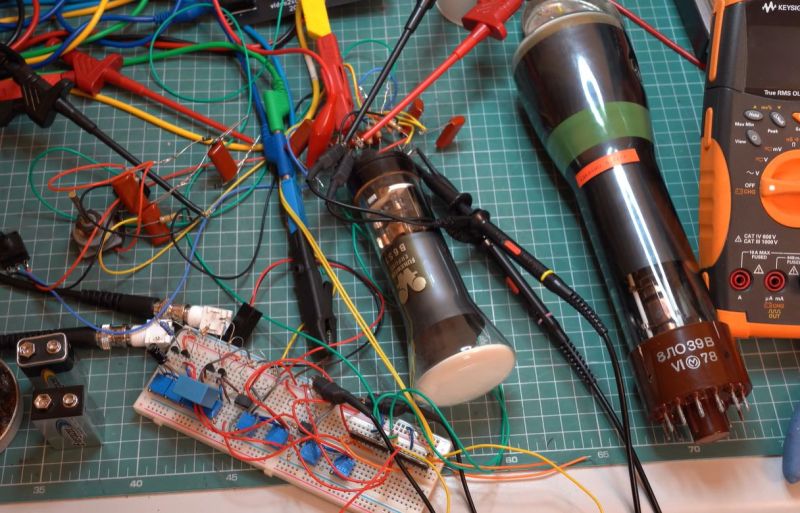
Regardless of whether it’s just a simple monochrome CRT in an oscilloscope or a full RGB CRT, the basic steps to make it work in a device remain the same. In a recent video by [Void Electronics] these steps are worked through, including the biasing at the end that is necessary to get a stable image.

A big part of installing a CRT and driving it is knowing how to read its datasheet. Much like other vacuum tube types, there are heaters, control grids and a range of voltages to get right and keep happy. Even then you can still have a situation where you must troubleshoot problems, which is also touched upon in the video. All of this is demonstrated using an RFT B6S1 CRT as the subject, including how to build your own bias circuit.

Despite calling it an “obsolete skill”, there is still a lot of demand for CRTs in vintage lab equipment, arcade restorations and far more obscure fields that still have new CRTs produced for them. Not to mention that even today CRTs have characteristics that make them competitive with flat-screen technologies.

Read more
Facial Recognition on Public Buses? Kansas City Says Yes

An anonymous reader shared this report from the Associated Press: Officials in Kansas City, Missouri, are preparing to equip cameras on some public buses with facial recognition software capable of identifying passengers who appear on a list of banned riders or missing persons. Supporters and opponents alike view the effort as a major litmus test for tapping the AI-powered software on a U.S. public transportation system, positioning Kansas City as the latest epicenter of a fierce debate over whether the safety benefits of artificial intelligence are worth the privacy costs. "The idea of running face recognition on a camera that is pointed on live spaces in public is a line that until recently has never really been crossed in the last 25 years," said Jay Stanley, senior policy analyst for the Project on Speech, Privacy and Technology at the American Civil Liberties Union. The state of Missouri declined to help fund the project as expected due to concerns with the facial recognition component. Still, the city is pushing ahead with local and federal money, said Tyler Means, chief mobility and strategy officer at the Kansas City Transportation Authority. "Privacy is always a tricky thing," Means said. "We've always had cameras on our buses. It's just new technology. I think in time it'll smooth over and people will realize, 'Well, it didn't really feel any different'...." Images captured by cameras aboard the buses would immediately be checked against any active alerts, generated when a missing person, banned rider or someone on a law enforcement watch list designated by the transportation authority is identified... After the buses return to the depot, the transportation authority would archive the regular video footage on a local server for up to five years. The company partnering with Kansas City to run the cameras "started using live facial recognition years ago to alert nursing homes when residents left the building," according to the article, and then "brought the technology to correctional institutions and schools." But this is its first attempt at bringing its cameras onto public transportation. The article also includes this quote from Will Owen, communications director for the Surveillance Technology Oversight Project. "City residents should not be guinea pigs for transit systems to test Silicon Valley's latest unproven, biased surveillance tech."

Read more of this story at Slashdot.

Read more

We would like to send you notifications.

Accept